| An exceptional high-impact exploration opportunity
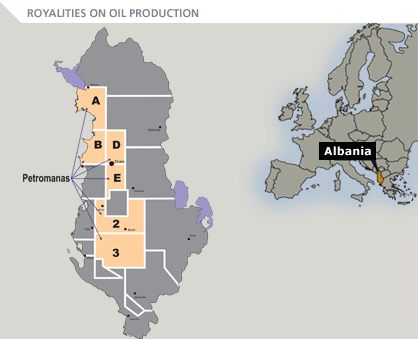
Manas is in the final stage of acquiring two production sharing agreements (PSAs) covering over 3,000 square kilometers in four blocks on the northern flank of Albania's oil rich fold and thrust belt. The agreements, which cover blocks A, B, D and E, have been approved by the National Agency of Natural Resources (AKBN) and now await final ratification by the Energy Ministry.
The blocks were previously operated by Shell Exploration and Production, and Corporex.
The Manas blocks are located north of shallow high-sulfur heavy oil production with an estimated 2.7 billion barrels of oil in place and cumulative production of 350 million barrels. Critically, recent deep oil discoveries show the deeper sections to contain 30-35 API low sulfur oil at depths below 3,000 to 3,500 meters. The primary exploration targets are sub-thrust fractured carbonate reservoirs similar to those discovered in the 1990s in the Appenines of Italy. During the 1990s Shell and Corporex discovered a deep under-thrust structure, within the blocks which, by their calculations, has the potential to contain a combined 820 million barrels (recoverable) of oil. Manas has this opportunity because Shell and Corporex suspended all exploration activity and abandoned the PSA's in reaction to the extreme unrest in Albania and the conflict in neighboring Kosovo.
North and South Tirana Prospect
Manas' primary exploration targets are deep (4.0 kilometers), sub-thrust fractured carbonate reservoirs. 2D seismic imaging from the 1990s revealed a large carbonate sub-thrust, extending over blocks B, D and E with two culminations:
- South Tirana, a prospect at 4,600 m in Block E (analogous to the Cakran oil and gas field); and
- North Tirana prospect at 3,750, extending onto blocks B, D and E, including the Rinas prospect. These structural prospects indicate recoverable reserves of 260 million barrels in South Tirana and 580 million barrels in the Rinas prospect. Below 5,100 metres, the North and South Tirana prospects merge into a single 170 square kilometre structural closure. In that case, reserves of more than one billion barrels could be present in the Tirana sub thrust anticline.
|
On the Manas blocks a thrust sheet called the Kryja outcrops and is made up of older massive Cretaceous (formed 145 million to 65 million years ago) to much younger Eocene limestones with multiple seepages of oil. The Kryja is over-thrust on top of the Ionian thrust sheet, which is the targeted reservoir and holds all Albanian reserves. The Ionian thrust sheet's source rocks are more ancient Jurassic carbonates and shales formed from 199 to 145 million years pervious. They are covered by Cretaceous to Eocene Limestone reservoir rocks which are then sealed by thick Miocene (within the Neogene period) flysch. |
During the 1990s Shell Oil and Corporex acquired approximately 1800 kilometers of seismic on these concessions. They discovered a deep under-thrust structure, which, by their calculations, has the potential to contain a combined 820 million barrels (recoverable) of oil.
When both Shell and Corporex abandoned their projects in the late 1990s (after spending just over $25 million on the blocks Manas is acquiring) Albania was in a state of total chaos. Like many ex-communist states Albania's political and economic system had collapsed. At the time it was impossible to predict whether it would get better or worse. Shell and Corporex decided to escape the turmoil, in essence allowing Manas to later acquire these superbly defined, giant, virtually drill ready prospects.
Recent deep light oil discovery significantly reduces exploration risk
A 2005 light oil discovery by Occidental Petroleum approximately 50 Kilometers south of the Manas blocks, has established that the same thrust sheet as the Tirana sub thrust anticline is Ionian and does in fact contain oil. This fact substantially reduces the ABDE blocks' exploration risk as it greatly increases the probability that the giant anticline outlined by Shell and Corporex seismic is in fact the oil-saturated Ionian formation. |
Albania has petroleum resources both on and offshore, and shares geologic trends with the neighboring Balkan states of Croatia; Serbia and Montenegro; Macedonia; and Greece.
The country harbors one of the largest onshore oil fields in Europe, Patos-Marinza, discovered in 1928. Albania's oil production peaked in 1975 and then declined until 1982, when a more rapid decline set in, due to lack of funding for field development and technical expertise.
Still, until 1989, Albania was a net exporter of petroleum products. But by 2001, the country was importing 73% of what it consumed. Albania made efforts in the 1990s to attract foreign capital and technology after the communist economic system broke down. Petroleum was the first industry to attract direct foreign investments in Albania when the government successfully negotiated with foreign drilling and exploration firms for onshore and offshore prospecting. In the last 15 years, the country has licensed drilling to American, Austrian, Canadian, Croatian, Greek, and Swedish companies. According to a World Bank report, 4,666 oil wells have been drilled, of which 3,123 wells are operating and 981 wells are shut in or abandoned.
The Manas blocks are located north of shallow, high-sulfur, heavy oil production with an estimated 2.7 billion barrels of oil in place and cumulative production of 350 million barrels. Critically, recent deep oil discoveries show the deeper sections to contain 30-35 API low sulfur oil at depths below 3,000 to 3,500 meters.

Oil and Gas Exploration in Albania Today
Albania possesses important oil reserves and produces about 350,000 tons of oil annually. Driven by high oil prices, the need for energy security in Europe, and a strategically desirable location close to all European markets, Albania is an active oil marketplace with several companies negotiating or seeking to negotiate for acreage. Large independents and major oil companies have been operating in the country for a number of years and the government has a clear policy to attract foreign investment in its natural resource sector. |
Greatly Improved Political and Business Environment
Similar to the Production Sharing Agreement's potential, Albania's political and business prospects have dramatically improved. Albania is a small country with a population of only 3.5 million. Consequently, the financial and technical assistance from the European Union is quickly having a dramatically positive effect. The country is being rebuilt with the help of billions of Euros from the European Union in conjunction with Stabilization and Association Agreement (SAA) between the EU and Albania. At the same time, the inflow of investment from Albanians abroad is estimated to exceed $1 billion annually. As a further indication of its improved stability and prospects Albania is expected to join NATO in 2008.
Fast Facts
- Parliamentary elections took place in July-August 2005 and were won by the Democratic Party
- Stabilization and Association Agreement (SAA) between Albania and the European Union
- Low working costs
- Increasing foreign direct investment
- Developing market economy
- Favourable operating climate for foreign companies
- Strong GDP growth
- Moderate inflation
- On-going privatization process presents opportunities in resource sectors, including oil and gas
- Developed financial sector
 | |