Manas Petroleum Corp
Operations
Manas Petroleum CorpAlbania
Show printable version of 'Albania Facts - History of Oil & Gas' in a New Window
Email 'Albania Facts - History of Oil & Gas' to a friend
Albania Facts

Albania has petroleum resources both on and offshore, and shares geologic trends with the neighboring Balkan states of Croatia; Serbia and Montenegro; Macedonia; and Greece.

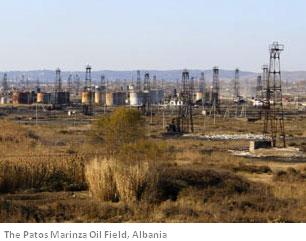
The country harbors one of the largest onshore oil fields in Europe, Patos-Marinza, discovered in 1928. Albania's oil production peaked in 1975 and then declined until 1982, when a more rapid decline set in, due to lack of funding for field development and technical expertise.

Still, until 1989, Albania was a net exporter of petroleum products. But by 2001, the country was importing 73% of what it consumed. Albania made efforts in the 1990s to attract foreign capital and technology after the communist economic system broke down. Petroleum was the first industry to attract direct foreign investments in Albania when the government successfully negotiated with foreign drilling and exploration firms for onshore and offshore prospecting. In the last 15 years, the country has licensed drilling to American, Austrian, Canadian, Croatian, Greek, and Swedish companies.


The Patos Marinza Oil Field, Albania


Oil and Gas Exploration in Albania Today

Driven by high oil prices, the need for energy security in Europe, and a strategically desirable location close to all European markets, Albania is an active oil marketplace with several companies negotiating or seeking to negotiate for acreage. Large independents and major oil companies have been operating in the country for a number of years and the government has a clear policy to attract foreign investment in its natural resource sector.
Greatly Improved Political and Business Environment

Similar to the Production Sharing Agreement's potential, Albania's political and business prospects have dramatically improved. Albania is a small country with a population of only 3.5 million. Consequently, the financial and technical assistance from the European Union is quickly having a dramatically positive effect. The country is being rebuilt with the help of billions of Euros from the European Union in conjunction with Stabilization and Association Agreement (SAA) between the EU and Albania. At the same time, the inflow of investment from Albanians abroad is estimated to exceed $1 billion annually. As a further indication of its improved stability and prospects Albania is expected to join NATO in 2008.

Fast Facts
  • Parliamentary elections took place in July-August 2005 and were won by the Democratic Party
  • Stabilization and Association Agreement (SAA) between Albania and the European Union
  • Low working costs
  • Increasing foreign direct investment
  • Developing market economy
  • Favourable operating climate for foreign companies
  • Strong GDP growth
  • Moderate inflation
  • On-going privatization process presents opportunities in resource sectors, including oil and gas
  • Developed financial sector


The Patos Marinza Oil Field, Albania